
Cheek Support
Before and after cheek filler planned around midface support and facial proportion.
Structure And Proportion
At Aster, we start by looking at how your facial structure and soft tissue have changed over time. When dermal filler is appropriate, we use it selectively to restore support and bring your features into balance while preserving what makes your face yours.
We assess your anatomy, facial proportions, tissue quality, and how your face moves at rest and in expression. Your treatment history, including any previous filler, and your long-term goals help guide whether and where we recommend treatment.

Areas treated with dermal filler to achieve this comprehensive result: Cheek, Undereye, Pyriform (beside nose), Submalar (under cheek/in front of ear), Chin, Chin shadow.
Dermal Filler In Practice
Real Aster results selected from the existing treatment gallery. Results vary by patient, product, placement, and treatment plan.
Before and after cheek filler planned around midface support and facial proportion.

A lower-face result addressing the nasolabial folds, marionette lines, chin shadow, and lips.

A facial balancing result that included filler in the lips, cheek, chin, and chin shadow.

Chin, jawline, marionette lines, and chin shadows treated together to restore definition, soften shadows, and bring the lower face into balance.

Lower facial balancing with dermal filler

Lower facial balancing with dermal filler

Lower facial balancing with dermal filler

Facial Balancing by Fallon Holloway RN BSN CANS

Facial Balancing by Fallon Holloway RN BSN CANS
TREAT THE FACE
What you notice may not be where treatment begins. Changes in bone structure, facial fat, collagen, and tissue support can affect how other areas of the face look over time.
At Aster, we assess the whole face to understand what is contributing to your concern and where treatment can create a natural, balanced improvement.
Filler is recommended when it adds meaningful value to your individualized plan. Natural results are not simply about using less product. They come from understanding where support is needed, how much is appropriate, and when treatment is best left alone.

The Aster Approach
You know what bothers you. Our role is to understand why it is happening and which treatment can meaningfully improve it.
Changes in bone, facial fat, and skin support can contribute to the folds, hollows, and shadows you notice. Addressing those underlying changes may mean treating somewhere other than the area that first brought you in.
At Aster, we treat faces, not features. We listen to your concerns, assess the whole face, and explain our recommendations so your plan addresses the cause of what you see, with your goals at its center.

How We Plan
Product choice, amount, and placement depend on your anatomy and the role filler needs to serve in each area.
Restore support where changes in bone and facial fat have affected the contours and proportions of the face.
Refine the relationship between the cheeks, chin, jawline, and lips, considering how they balance from every angle.
Soften selected hollows and transitions between areas of the face to create a more harmonious contour, without treating every line individually.
FULL FACE ASSESSMENT
No feature exists in isolation. We assess how structure, proportion, movement, and skin quality work together, then build an individualized plan around what will create the most meaningful improvement.
We assess the underlying support that shapes the face, including the temples, cheeks, chin, and jawline. Restoring support where needed can improve facial balance and the way surrounding areas relate to one another.
Under-eye hollows, folds, and transitions are evaluated alongside the structures around them. Sometimes the most natural improvement comes from restoring nearby support rather than treating the visible concern directly.
Lip shape, movement, and the support around the mouth guide treatment, along with overall facial proportion. The goal is to refine shape and balance in a way that feels natural to your face.
Treatment Goals
Your plan may focus on one area or build over several visits, guided by your anatomy, existing support, and goals.
Restore cheek support where needed to improve contour and soften transitions into the lower face.
Assess chin projection, lip position, and the relationship between the nose and chin together.
Improve contour and definition where your underlying structure and tissue quality make filler appropriate.
Refine shape, volume, and balance according to your anatomy, movement, and surrounding features.
Soften appropriate hollows and shadows with product choice and placement tailored to the tissue.
Evaluate existing filler to determine whether adding, allowing more time, or dissolving will best support your goals.
Your Treatment
We begin with what you notice, what you hope to improve, and your experience with previous treatments. Your goals guide the conversation, including your preferences, timeline, and comfort with a gradual approach.
We assess the face as a whole, considering bone structure, facial fat, muscle movement, skin quality, and tissue support. Understanding how these layers interact helps us identify the changes contributing to your concern, even when treatment needs to begin somewhere else.
Addressing changes that have developed over years or decades often requires several sessions and a combination of treatments. A corrective plan may involve restoring structural support, refining proportions, and improving skin quality in stages.
Maintenance builds on what has already been achieved. It may involve a single session for a specific concern, with treatment timing guided by your results and how your face continues to change.
We explain what each recommended treatment can accomplish, where its limitations lie, and what makes sense to address first. Filler may be one part of your plan, alongside treatments for muscle movement, collagen, texture, or other aspects of skin quality.
Addressing the contributing layers over time allows each treatment to support the next, creating a more balanced, natural result.
You’ll receive clear aftercare guidance and a follow up plan that allows us to evaluate your results as they settle. We reassess before deciding what comes next, adjusting your care to preserve balance as your needs evolve.
The recommended sequence and expected cost are reviewed before treatment.
Your treatment care
Care cards from Aster Aesthetics. View the original card or read its text below.
 View full care card (PDF)
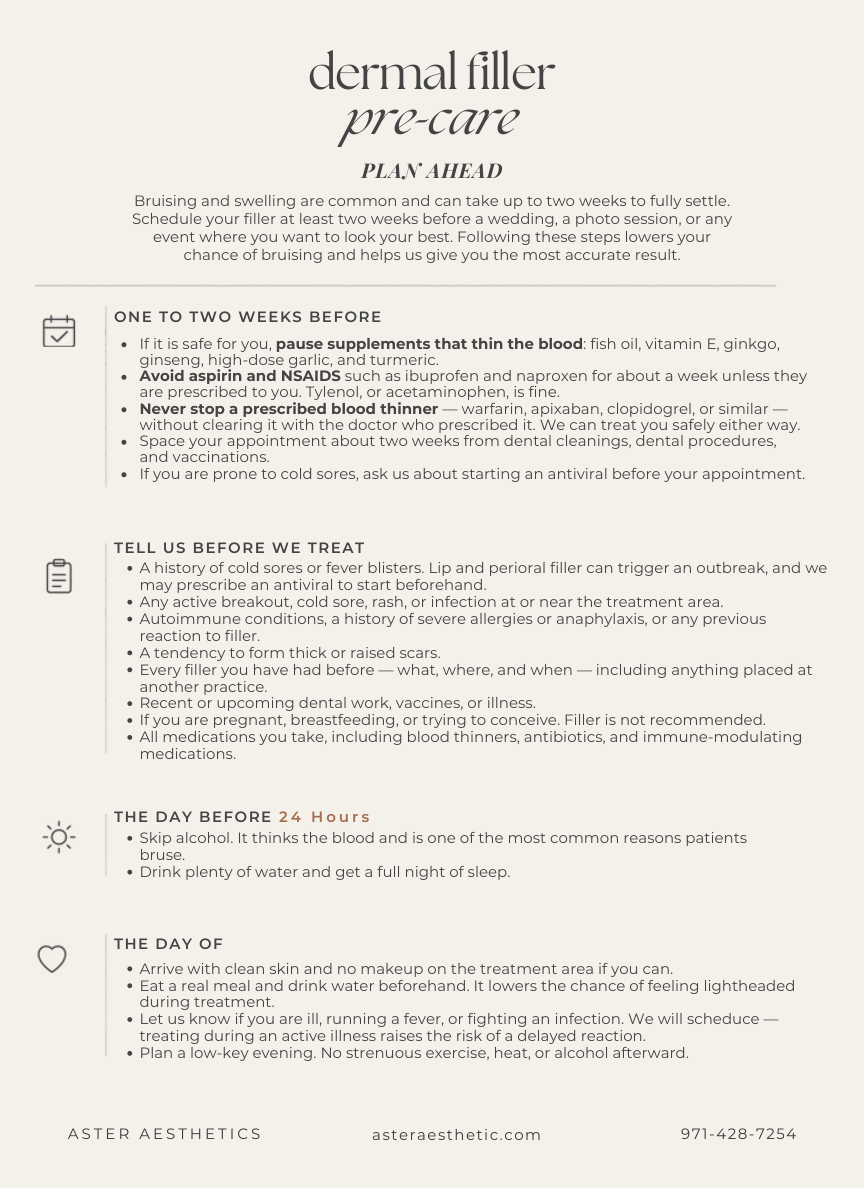
dermal filler
pre-care
PLAN AHEAD
Bruising and swelling are common and can take up to two weeks to fully settle. Schedule your filler at least two weeks before a wedding, a photo session, or any
event where you want to look your best. Following these steps lowers your
chance of bruising and helps us give you the most accurate result.
ONE TO TWO WEEKS BEFORE
If it is safe for you, pause supplements that thin the blood: fish oil, vitamin E, ginkgo, ginseng, high-dose garlic, and turmeric. Avoid aspirin and NSAIDS such as ibuprofen and naproxen for about a week unless they are prescribed to you. Tylenol, or acetaminophen, is fine. Never stop a prescribed blood thinner — warfarin, apixaban, clopidogrel, or similar — without clearing it with the doctor who prescribed it. We can treat you safely either way. Space your appointment about two weeks from dental cleanings, dental procedures, and vaccinations. If you are prone to cold sores, ask us about starting an antiviral before your appointment.
TELL US BEFORE WE TREAT
A history of cold sores or fever blisters. Lip and perioral filler can trigger an outbreak, and we may prescribe an antiviral to start beforehand. Any active breakout, cold sore, rash, or infection at or near the treatment area. Autoimmune conditions, a history of severe allergies or anaphylaxis, or any previous reaction to filler. A tendency to form thick or raised scars. Every filler you have had before — what, where, and when — including anything placed at another practice. Recent or upcoming dental work, vaccines, or illness. If you are pregnant, breastfeeding, or trying to conceive. Filler is not recommended. All medications you take, including blood thinners, antibiotics, and immune-modulating medications.
THE DAY BEFORE
2 4 H o u r s
Skip alcohol. It thinks the blood and is one of the most common reasons patients bruse. Drink plenty of water and get a full night of sleep.
THE DAY OF
Arrive with clean skin and no makeup on the treatment area if you can. Eat a real meal and drink water beforehand. It lowers the chance of feeling lightheaded during treatment. Let us know if you are ill, running a fever, or fighting an infection. We will scheduce — treating during an active illness raises the risk of a delayed reaction. Plan a low-key evening. No strenuous exercise, heat, or alcohol afterward.
971-428-7254 A S T E R A E S T H E T I C S asteraesthetic.com
 View full care card (PDF)
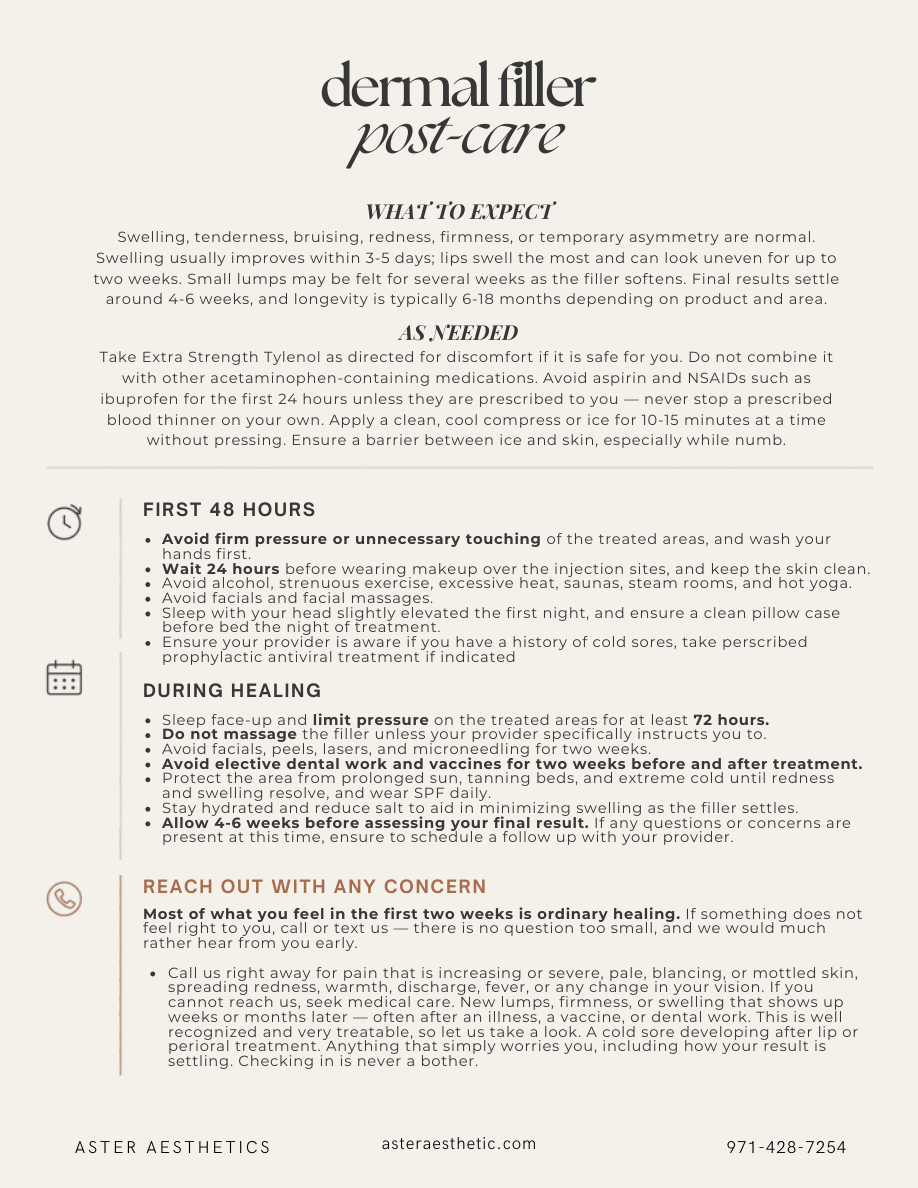
dermal filler
post-care
WHAT TO EXPECT
Swelling, tenderness, bruising, redness, firmness, or temporary asymmetry are normal. Swelling usually improves within 3-5 days; lips swell the most and can look uneven for up to two weeks. Small lumps may be felt for several weeks as the filler softens. Final results settle
around 4-6 weeks, and longevity is typically 6-18 months depending on product and area.
AS NEEDED Take Extra Strength Tylenol as directed for discomfort if it is safe for you. Do not combine it
with other acetaminophen-containing medications. Avoid aspirin and NSAIDs such as ibuprofen for the first 24 hours unless they are prescribed to you — never stop a prescribed
blood thinner on your own. Apply a clean, cool compress or ice for 10-15 minutes at a time
without pressing. Ensure a barrier between ice and skin, especially while numb.
FIRST 48 HOURS
Avoid firm pressure or unnecessary touching of the treated areas, and wash your hands first. Wait 24 hours before wearing makeup over the injection sites, and keep the skin clean. Avoid alcohol, strenuous exercise, excessive heat, saunas, steam rooms, and hot yoga. Avoid facials and facial massages. Sleep with your head slightly elevated the first night, and ensure a clean pillow case before bed the night of treatment. Ensure your provider is aware if you have a history of cold sores, take perscribed prophylactic antiviral treatment if indicated
DURING HEALING
Sleep face-up and limit pressure on the treated areas for at least 72 hours. Do not massage the filler unless your provider specifically instructs you to. Avoid facials, peels, lasers, and microneedling for two weeks. Avoid elective dental work and vaccines for two weeks before and after treatment. Protect the area from prolonged sun, tanning beds, and extreme cold until redness and swelling resolve, and wear SPF daily. Stay hydrated and reduce salt to aid in minimizing swelling as the filler settles. Allow 4-6 weeks before assessing your final result. If any questions or concerns are present at this time, ensure to schedule a follow up with your provider.
REACH OUT WITH ANY CONCERN
Most of what you feel in the first two weeks is ordinary healing. If something does not feel right to you, call or text us — there is no question too small, and we would much rather hear from you early.
Call us right away for pain that is increasing or severe, pale, blancing, or mottled skin, spreading redness, warmth, discharge, fever, or any change in your vision. If you cannot reach us, seek medical care. New lumps, firmness, or swelling that shows up weeks or months later — often after an illness, a vaccine, or dental work. This is well recognized and very treatable, so let us take a look. A cold sore developing after lip or perioral treatment. Anything that simply worries you, including how your result is settling. Checking in is never a bother.
AS TE R AE S TH E TICS asteraesthetic.com 971-428-7254
Dermal Filler FAQ
At Aster, the goal is a natural result that fits your face. We assess your anatomy, existing filler, and overall proportions to guide product choice, placement, and amount. Our approach uses filler to restore support and refine balance, not add volume in excess
Your care continues after treatment. If something concerns you, contact us so we can assess what you are experiencing and determine the appropriate next steps. An unwanted result may require time to settle, an adjustment, or consideration of dissolving. Hyaluronic acid filler can be dissolved with hyaluronidase, though this has its own risks and limitations.
A suspected complication requires prompt assessment. Unusual or worsening pain, changes in skin color, or vision changes require immediate medical attention. Do not wait for a routine follow up.
Many hyaluronic acid fillers have labeled results lasting approximately 12 to 24 months, depending on the product and treatment area. However, imaging studies show that filler can remain in some areas for several years, beyond the duration traditionally quoted. Remaining filler does not necessarily mean the visible result stays the same.
This longevity can support lasting results when filler is appropriately chosen and placed. Repeat treatments may build on product that is still present, which is why we reassess your support, proportions, and existing filler before recommending more. At Aster, maintenance is guided by what your face needs, rather than a fixed schedule.
PubMed sourceHyaluronic acid filler provides immediate support and volume to restore contours, refine shape, and improve facial balance. Biostimulators encourage your body to produce collagen, with improvements developing gradually over time. Some products, such as Radiesse, can provide both immediate support and collagen stimulation.
At Aster, we recommend these treatments based on your structure, skin quality, and goals. They may serve different roles within the same plan.
Under eye concerns can reflect changes in skin quality, volume, fluid retention, and support from the surrounding face. We assess these factors along with your anatomy and previous treatments to determine whether filler is appropriate.
Some patients benefit from restoring cheek or midface support before treating the under eyes directly. Others may be better suited to treatments that stimulate collagen, improve skin quality, or surgery. Our recommendation addresses what is contributing to your concern, rather than assuming every hollow or shadow needs filler.
Existing filler is not a problem simply because it has been there for years. If it is providing appropriate support, maintaining natural contours, and allowing normal movement, it may not need to be dissolved.
We assess its placement and how it behaves within your tissue. If filler is visibly misplaced, distorting your shape or movement, or has migrated, particularly around the lips, we may recommend addressing it before adding more. The decision is based on how your filler is functioning, not its age alone.
Part Of A Bigger Picture
Explore a lip-specific plan guided by anatomy, movement, and facial proportion.
Explore Treatment → Whole-Face PlanningSee how multiple treatment types can be sequenced around the face as a whole.
Explore Treatment → Gradual Collagen SupportCompare Sculptra, Radiesse, and PRFM within a long-term plan.
Explore Treatment →Start With Structure
A consultation determines where filler may help, where another treatment fits better, and where no treatment is needed.