Melasma vs Sun Spots vs Post-Inflammatory Pigmentation

Most of the pigment you are looking at in August was made in June.
That is the part people find hardest to believe. You wore sunscreen. You were careful on the boat. And here you are at the end of summer with something on your cheekbone that was not there in May.
Pigment does not appear on the day it is caused. Melanocytes respond to injury over weeks, and the visible result surfaces long after the exposure that triggered it. Which is why late August is when the phone starts ringing, and why September through March is when we can actually do something about it.
But before any of that matters, there is a question that has to be answered first, and almost nobody answers it correctly on their own.
What kind of pigment is it?
Because there are three common types, they look remarkably similar in a bathroom mirror, and they respond to completely different treatments. One of them can be made significantly worse by the treatment that clears another. Getting this wrong is expensive, and occasionally it sets people back years.
Why they look the same and aren't
All three are the same underlying process — melanocytes producing more pigment than usual — and all three show up as brown or grey-brown discolouration on the face. That is where the similarity ends.
What separates them is what triggered them, how deep the pigment sits, and how the skin behaves when you treat it.Those three things determine everything about what happens next.
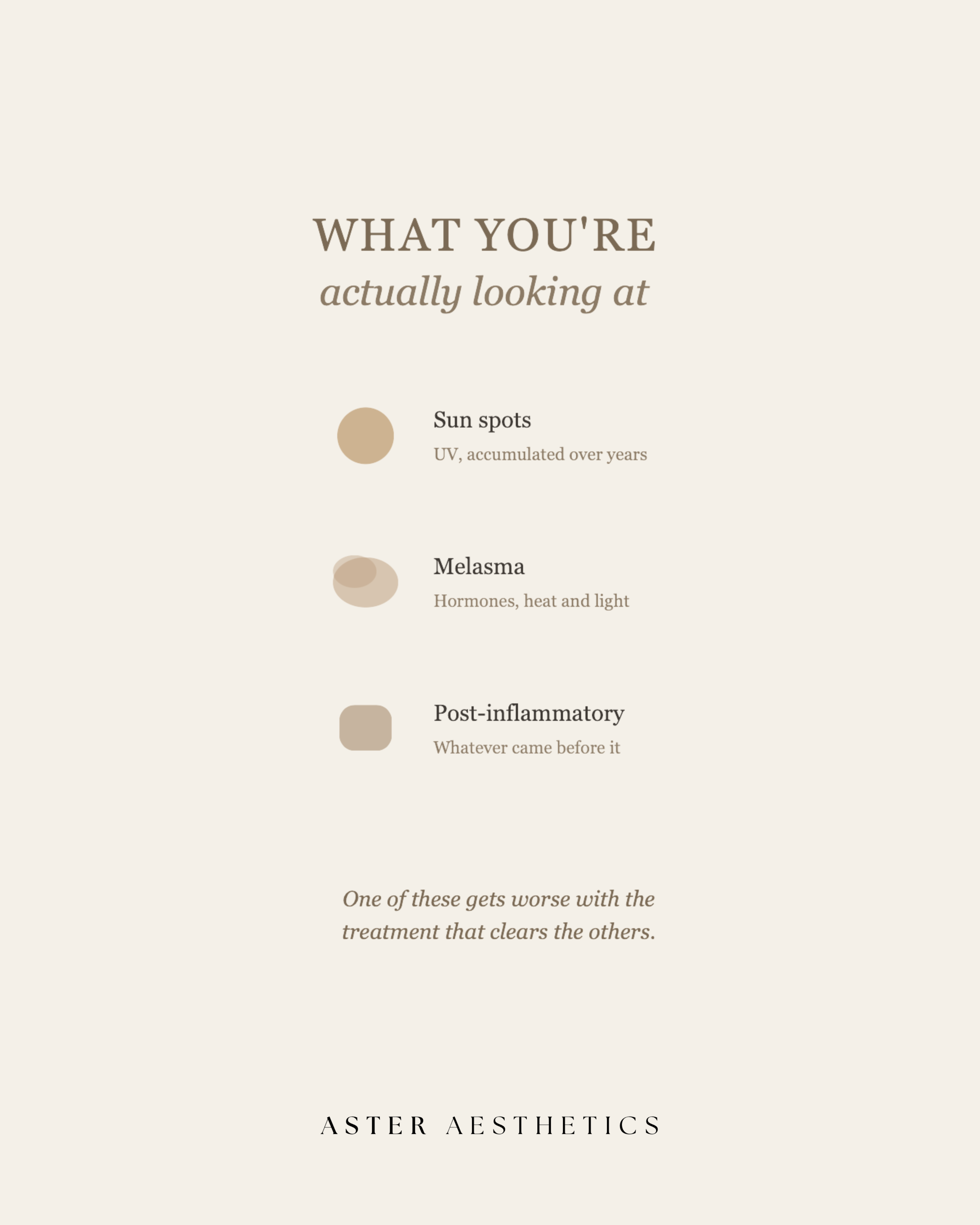
Sun spots
Also called solar lentigines, or age spots — a term we do not use, because they are not caused by age. They are caused by cumulative ultraviolet exposure, and you can find them on 30-year-olds who spent their twenties outdoors.
What they look like: discrete, sharply defined spots with clear borders. Light to medium brown. Usually round or oval, and they sit separately rather than blending into one another. You can point to where one ends.
Where they show up: the places that have taken the most sun. Cheekbones, temples, the bridge of the nose, forehead, the backs of the hands, the chest.
How they behave: they do not fade meaningfully in winter. They accumulate over years and tend to stay put.
Depth: primarily epidermal, in the upper layers of the skin. This is why they are the most treatable of the three.
Melasma
Melasma is a different animal, and it is the one people most often misidentify as sun spots.
What it looks like: patchy, blotchy, and diffuse rather than discrete. The edges are irregular and blurred. It is very often symmetrical — a similar patch on both cheeks, or a band across the forehead. Colour ranges from light brown to grey-brown.
Where it shows up: cheeks, forehead, upper lip, bridge of the nose, jawline. The symmetry is the giveaway.
What triggers it: ultraviolet light, but also heat, visible light, and hormones. This is the part that catches people out. Pregnancy, oral contraceptives, and hormone therapy are all common triggers. So is a hot yoga class, a commute with the sun on one side of your face, and the light coming off a phone screen. It is not only about UV, which is why a sunscreen that only protects against UV can feel like it is failing.
How it behaves: it worsens in summer, softens in winter, and returns. Reliably.
Depth: often mixed — epidermal and dermal. The dermal component is why melasma is the most difficult of the three, and why we are careful about how we phrase outcomes.
Melasma is managed, not cured. We say that early and plainly, because the practices that promise otherwise are the reason so many people arrive here disappointed. A well-run melasma plan can produce a genuine, visible, sustained improvement. It cannot promise the condition will not return, because the triggers do not go away.
Post-inflammatory hyperpigmentation
PIH is pigment left behind after the skin has been inflamed.
What it looks like: flat discolouration that matches the shape and position of whatever caused it. A spot where a breakout was. A line where a scratch was. A patch where a rash or a reaction was.
Where it shows up: anywhere the skin was injured or inflamed. It is not limited to sun-exposed areas, and that is often the clearest clue.
What triggers it: acne, eczema, an allergic reaction, picking, waxing, ingrown hairs, and — importantly — overly aggressive cosmetic treatment. A peel or laser that was too strong for the skin it was performed on can cause the exact problem it was meant to solve.
Who it affects: PIH occurs across all skin tones but is more common and more persistent in Fitzpatrick types IV through VI. This is one of several reasons provider experience matters more in pigment work than in almost anything else we do.
How it behaves: it usually fades on its own. Slowly — often over many months, sometimes longer.
The self-check
You will not diagnose yourself from a blog post, and we would not want you to. But three questions get most people to the right neighbourhood.
1. Can you point to where it ends? Sharp, defined borders point toward sun spots. Blurred, irregular, blending edges point toward melasma.
2. Is it symmetrical? A matching patch on both cheeks strongly suggests melasma. Sun damage is rarely that even, because your sun exposure never was.
3. Did something happen there first? If you can trace the mark back to a breakout, a scratch, a reaction, or a treatment, you are most likely looking at PIH.
If your honest answer to all three is I'm not sure, that is a normal answer, and it is the reason consults exist.
What treats each — and what makes each worse
This is where identification stops being academic.
Sun spots respond well to resurfacing and light-based treatment. Laser resurfacing targets the pigment directly. Chemical peels address the epidermal component. Prescription-strength topicals, directed by a provider, support the result and help prevent recurrence. Of the three, this is the one where meaningful clearance is a reasonable expectation.
Melasma requires a different posture entirely. Aggressive heat-based treatment can worsen it — sometimes considerably — because heat is itself a trigger. Programs like Cosmelan work over months rather than appointments, paired with strict daily photoprotection. Tinted mineral sunscreen containing iron oxide matters here specifically, because iron oxide is what blocks visible light, and visible light is part of what drives melasma. A standard clear sunscreen does not do that job.
PIH starts with the inflammation, not the pigment. If the acne is active, the acne is the treatment plan. Resurfacing inflamed skin tends to produce more PIH, not less. Once the underlying cause is settled, gentle topicals and time do most of the work.
The single most important line in this article is this one: a laser that reliably clears sun spots can make melasma worse. They are not interchangeable problems, and they are not interchangeable treatments.
Why identification comes before booking
Every pigment plan we build starts with working out what we are actually treating, on your skin, in person, under proper lighting. Sometimes that involves more than one type at once, which is common and changes the sequencing.
Then the plan gets built in an order. Skin health first, because compromised skin pigments more readily. Photoprotection always, because none of this holds without it. Then correction, timed to the season — which is why we treat pigment between September and March, and why we spend August getting skin ready rather than treating it.
Every treatment plan begins with your skin — not the treatment.
What we would do first
If you are reading this in August with something on your face that was not there in May, here is the honest sequence.
Get identified. Get your barrier and your daily photoprotection in order, because both change what is possible in the fall. Then book the correction for the season when it will actually work.
Correction season opens in September. Booking now is how you get the dates.
Book a skincare consult — we will tell you what you are looking at, and what it will realistically take.

We’re proud to care for patients in Salem, Keizer, and throughout Marion County, while welcoming patients from across the Willamette Valley. Our approach centers on natural, balanced results, with a strong focus on long-term skin health and integrity. Wherever you’re starting, we meet you there —creating personalized plans that evolve with you and deliver refined, intentional results